



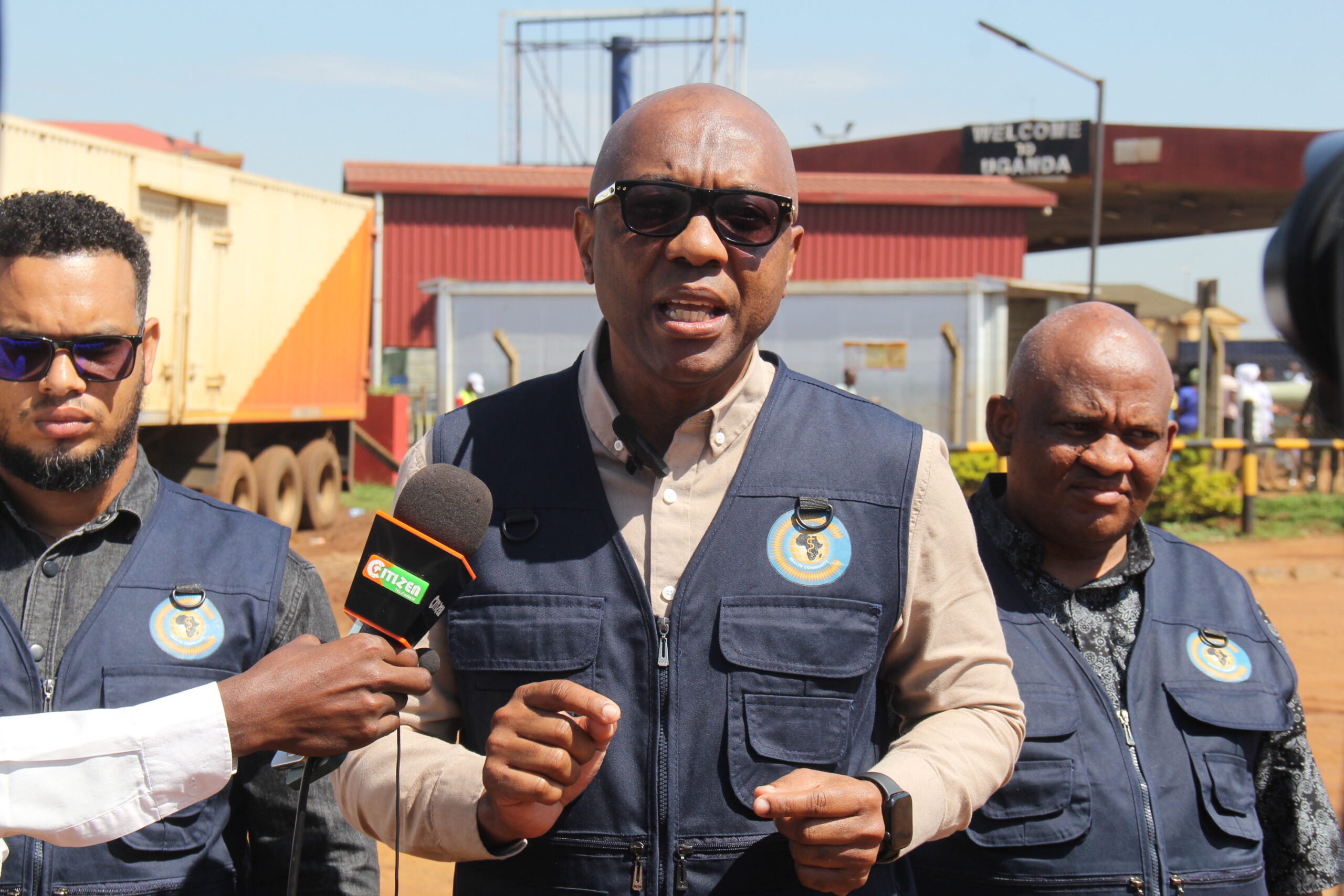
By Rodgers Omondi, Busia
The East, Central and Southern Africa Health Community (ECSA-HC) has led a joint Ebola preparedness and readiness assessment at the Busia border to evaluate the capacity of Kenya and Uganda to detect, report and respond to possible Ebola cases amid ongoing concerns over the disease in the region.
Speaking during the assessment at the Busia border point, ECSA-HC Senior Medical Epidemiologist Dr. Mohamed Mohamed said the exercise focused on strengthening early detection, prompt reporting and rapid response mechanisms at points of entry.
“We have identified that both sides are well prepared to handle Ebola when a case arises. We are looking at human resources that can handle patients, PPEs, facilities to isolate, transport and treat patients if we have a case,” said Dr. Mohamed.
He said the regional body has been facilitating workshops bringing together health officials and stakeholders from Kenya and Uganda to improve information sharing and identify gaps that require intervention.
“We are assessing how they communicate, data sharing, surveillance and how they deal with suspected cases, isolation facilities and treatment to prevent the disease from one country to another,” he added.
Dr. Mohamed emphasized the need for community involvement in surveillance efforts, noting that local residents play a crucial role in identifying and reporting suspected cases.
“We need to involve the community because they are important in surveillance. We want them to be empowered so that they can report suspected cases and help us understand population movement across the border,” he said.
Busia County Director of Health and Public Sanitation Joseph Oprong said the county has trained frontline health workers and enhanced preparedness at health facilities.
“We have already trained our health officers and the assessment of our isolation centre at Alupe is ongoing. We are also assessing quarantine facilities so that any identified case can be managed effectively,” said Oprong.
He urged residents to use official border crossing points to facilitate screening and reduce the risk of disease transmission through porous borders.
“We are calling on everyone using this border point to ensure they are screened and thoroughly wash their hands. We are discouraging the use of porous borders so that we can prevent the disease from entering our country,” he said.
Oprong confirmed that no suspected Ebola case has been reported in Busia County, adding that a mobile laboratory has been established at Busia County Referral Hospital to support specimen handling and testing.
On the Ugandan side, Assistant Commissioner for Disease Surveillance Dr. Michael Mwanga said the country has recorded 11 confirmed Ebola cases, with one death reported.
“Currently we have 11 confirmed cases. Unfortunately, we lost one person, but the remaining 10 are doing well under the care and support of health officers,” said Dr. Mwanga.
He expressed confidence that ongoing collaboration between Kenya and Uganda would help contain the outbreak, noting that both countries have strengthened screening, isolation and referral systems at border points.
Faith Tum of the National Biosafety Authority, who participated in the simulation exercise, said border officials are now better equipped to respond to Ebola cases.
“We now have insights on mitigation measures and preparedness towards the pandemic. Security personnel and health workers will continue coordinating to ensure those using porous borders are screened,” she said.