


By Faith Anene
The leaders of the united opposition have launched a blistering attack on President William Ruto’s administration, alleging a vast and coordinated fuel scandal that they say has left millions of Kenyans shouldering the cost of political profiteering.
In a media briefing in Nairobi, the leaders who now call themselves “the United Alternative Government “painted a picture of what they describe as a “captured energy sector,” where public policy has been manipulated to benefit a powerful few individuals in the government at the expense of ordinary citizens.
They were led by former Deputy President Rigathi Gachagua, Kalonzo Musyoka, Justin Muturi, Fred Matiang’i and Eugene Wamalwa accused the government of orchestrating a scheme that has driven fuel prices to historic highs.
At the centre of their claims is a controversial government-to-government (G-to-G) fuel import framework involving major Gulf-based oil companies and selected Kenyan firms.
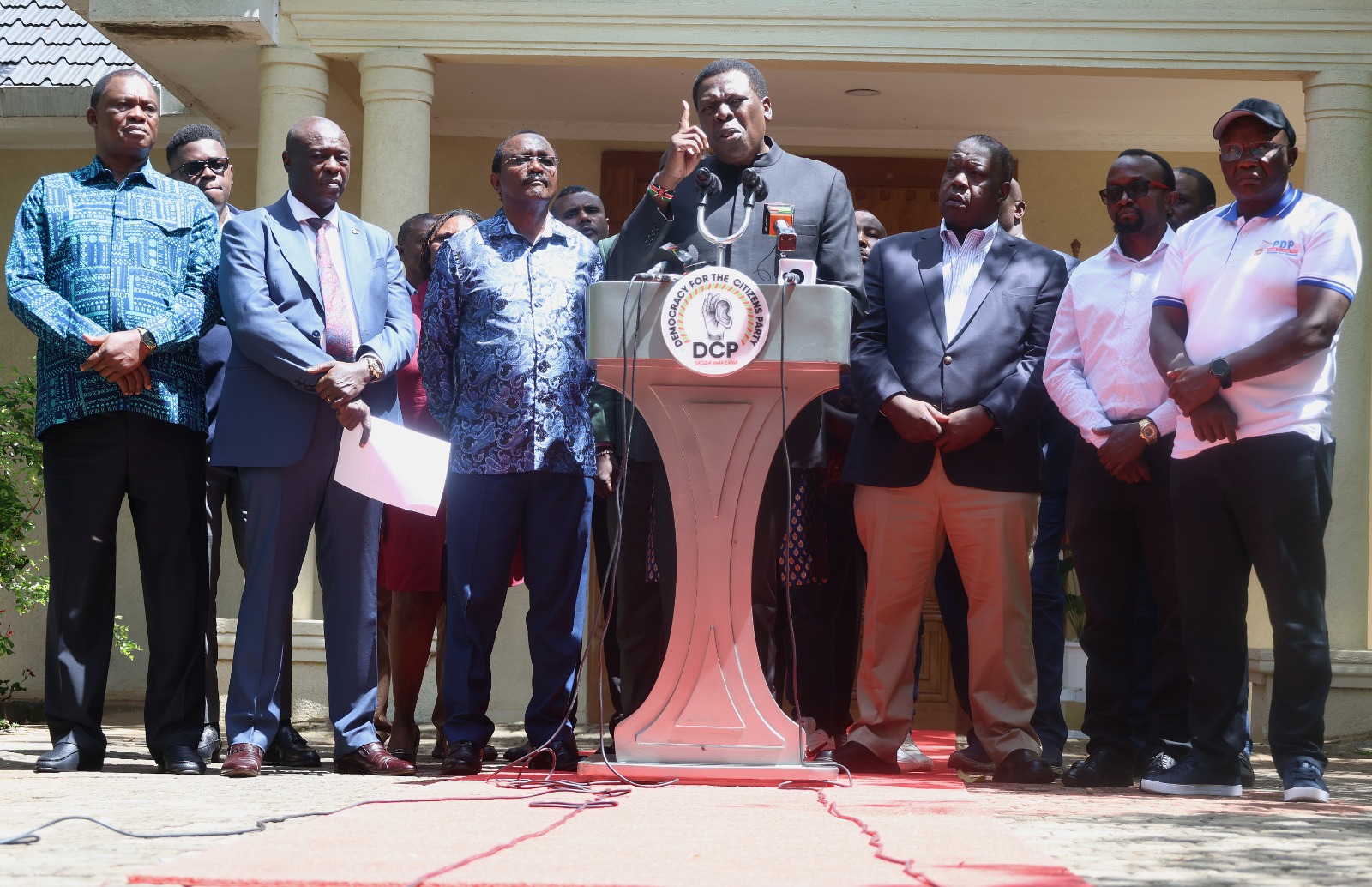
“This is not just another corruption case,” said Gachagua, leader of the Democracy for Citizens Party (DCP). “What we are witnessing is one of the most sophisticated economic crimes in Kenya’s history, executed within government systems, protected by state machinery, and paid for by struggling Kenyans.”
According to the opposition, the crisis began earlier this year when global supply disruptions linked to tensions in the Middle East affected fuel shipments through key routes such as the Strait of Hormuz.
The government, they say, had legitimate grounds to trigger emergency procurement measures under existing petroleum regulations. But instead of following due process, the opposition alleges, senior officials interfered to favour specific companies.
“They had an opportunity to protect Kenyans,” Gachagua added. “Instead, they chose profit over people.”
The controversy escalated in early April when three senior officials in Kenya’s energy sector, including former Petroleum Principal Secretary Mohamed Liban and former Energy and Petroleum Regulatory Authority (EPRA) Director General Daniel Kiptoo, were arrested in what the government described as a crackdown on “oil cartels.”
President Ruto publicly declared that the arrests signalled the end of entrenched corruption in the sector.
But opposition leaders have dismissed the move as a “carefully staged distraction.”
Kalonzo Musyoka, leader of the Wiper Democratic Movement, questioned the basis of the arrests.
“The government told Kenyans that cartels had been crushed. But weeks later, there are no charges. Why? Because those arrested followed the law,” he said. “The real actors remain untouched.”
Musyoka argued that the arrests were intended to deflect attention from what he described as “political interference at the highest level.”
Central to the dispute is a March 2026 emergency procurement process triggered by fears of a fuel shortage.
According to official records cited by the opposition, 13 oil marketing companies were invited to submit bids for contingency fuel supplies. Only four responded within the stipulated timeline.
Contracts were subsequently awarded to the two lowest technically compliant bidders, in line with procurement regulations.
However, the opposition alleges that a third company, Gulf Energy, submitted its bid late but was later forced into the process through political pressure.
Justin Muturi, leader of the Democratic Party, described the alleged intervention as “a textbook case of procurement manipulation.”
“You cannot change the rules midway because your preferred bidder lost,” Muturi said. “That is not governance; that is impunity.”
He added that the integrity of Kenya’s procurement system is now in question.
“When political directives override technical evaluations, institutions collapse,” he warned.
On April 14, fuel prices in Kenya surged dramatically, with petrol rising by Ksh28.69 per litre and diesel by Ksh 40.30, marking one of the steepest increases since independence.
For many Kenyans, already grappling with high living costs, the hike has been devastating.
Fred Matiang’i, Jubilee Party’s deputy leader, linked the price increase directly to the alleged scandal.
“Kenyans are now paying for a crisis that was manufactured,” he said. “This is not about global oil prices, it is about greed.”
Matiang’i pointed to regional comparisons, noting that neighbouring Uganda continues to record significantly lower pump prices despite relying on Kenyan infrastructure for fuel transit.
“How do you explain that?” he asked. “The answer is simple: inefficiency and exploitation.”
The opposition claims that the pricing changes could generate billions of shillings in profit for politically connected interests.
Eugene Wamalwa, leader of DAP-Kenya, said the figures point to a deliberate scheme.
“When you increase prices overnight and control the supply chain, you create an artificial profit margin,” he said. “This is economic sabotage dressed up as policy.”
Wamalwa accused senior government figures of using the Middle East crisis as a pretext to restructure fuel imports in their favour. “They saw an opportunity, and they took it,” he added.